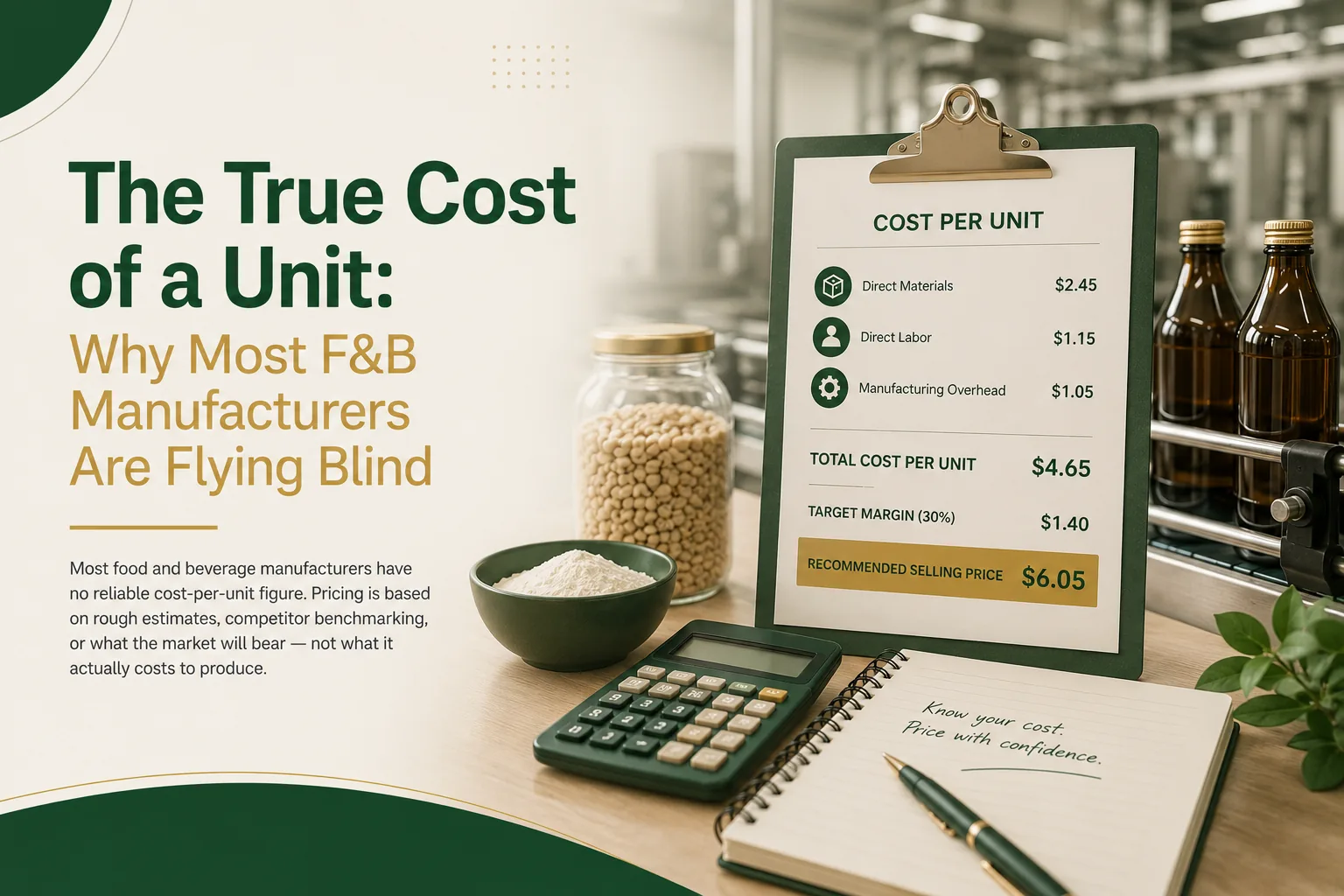
The True Cost of a Unit: Why Most F&B Manufacturers Are Flying Blind
Most food and beverage manufacturers have no reliable cost-per-unit figure. Pricing is based on rough estimates, competitor benchmarking, or what the market will bear — not what it actually costs to produce.
The Problem Nobody Talks About
Ask the average SME food manufacturer what it costs to produce one unit of their best-selling product, and you will get one of three answers:
- A number based on raw material cost only
- A rough estimate that "feels about right"
- An honest admission that they don't really know
All three are financially dangerous. The first ignores overhead and labor. The second is a guess with a decimal point. The third is at least honest — but doesn't solve the problem.
Why This Happens
Manufacturing cost accounting is genuinely complex. Unlike a trading business where the cost of goods sold is simply what you paid for inventory, a manufacturing business has three layers of cost:
- Direct materials — the raw ingredients or components in each unit
- Direct labor — the wages of workers directly producing the product
- Overhead — rent, utilities, maintenance, quality control, supervision, depreciation
Most SMEs only track the first layer consistently. The second is approximated. The third is almost never allocated to specific products.
The Cost Accounting Methodology
Building a proper cost-per-unit model requires five steps:
Step 1: Define the Bill of Materials (BOM)
Every product needs a precise, documented Bill of Materials — the exact quantity of each raw material required to produce one unit at standard yield. This means accounting for yield loss, waste, and off-spec production.
Step 2: Price the BOM at Moving Average Cost
Raw material prices fluctuate. Use a moving average cost (MAC) system rather than static purchase prices. This ensures your cost-per-unit reflects actual procurement costs, not last month's price.
Step 3: Calculate Direct Labor Cost
Determine the standard time required to produce one unit through each production stage. Multiply by the fully-loaded hourly cost (wages + benefits + employer contributions) of each worker category.
Step 4: Allocate Manufacturing Overhead
Calculate your total monthly manufacturing overhead (rent, utilities, maintenance, quality, depreciation). Divide by your budgeted production volume to get an overhead rate per unit or per machine hour.
Step 5: Build the Full Cost Card
The final cost card shows direct materials + direct labor + allocated overhead = total manufacturing cost per unit. Add your target margin and you have a scientifically derived selling price.
What Happens When You Have Real Cost Data
The business transformation that follows accurate cost data is predictable: unprofitable SKUs get repriced or discontinued, pricing negotiations with buyers are grounded in real cost data, production decisions are made based on contribution margin not revenue, and management can model the financial impact of raw material price changes in minutes.
Without cost data, you are flying blind. With it, you are flying with instruments.
Let's Diagnose Your Business
In one session, we identify your most critical constraint and show you what unlocking it would mean for your numbers.